How Solenis and Huron are bringing order to a Salesforce org built by 25 acquisitions
orgs scanned
25
acquisitions on one org;
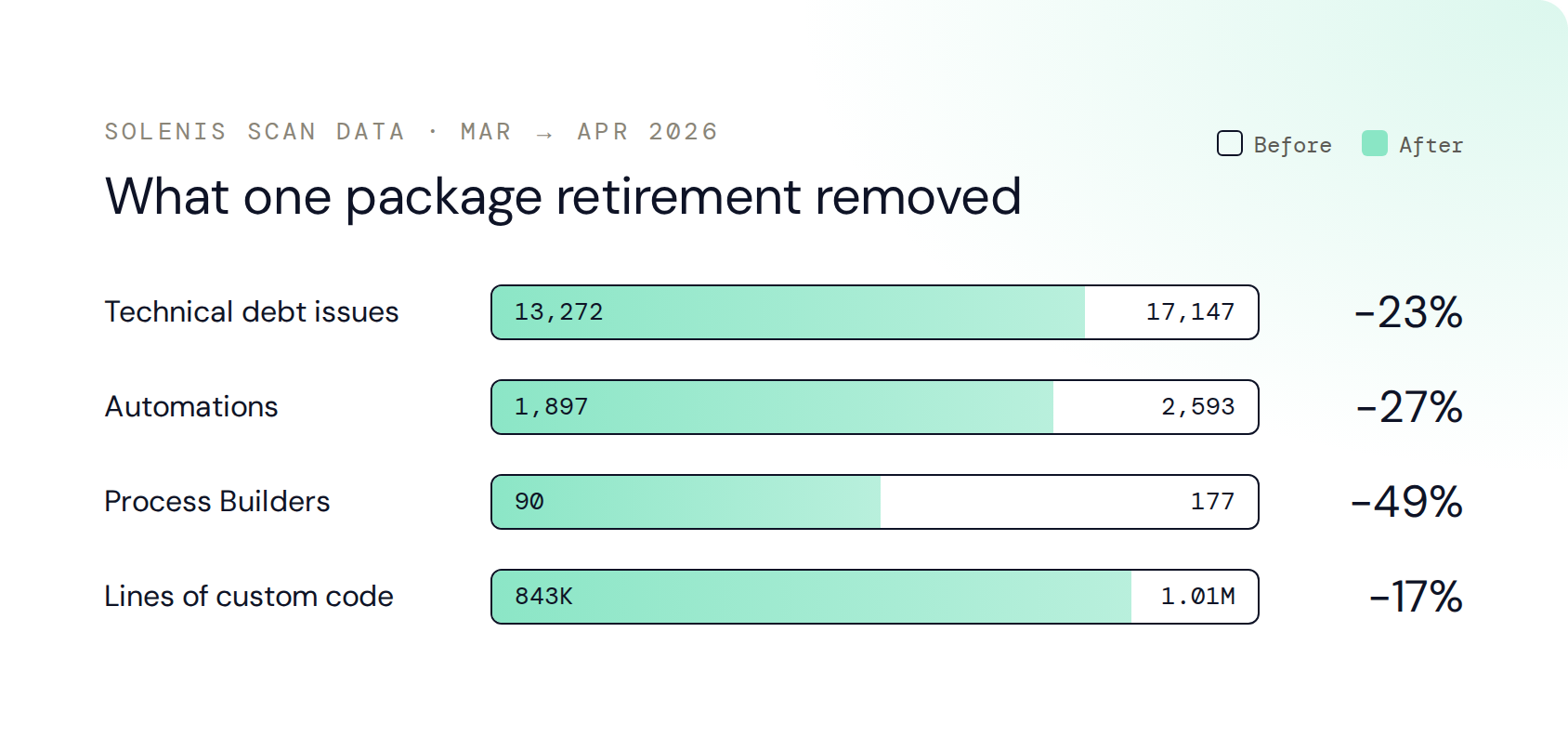
−49%
Process Builders (177 to 90);
−23%
technical debt from one package retirement

Solenis, a global provider of water and hygiene solutions, grew by acquiring about 25 companies in 10 to 12 years. Every deal added to one shared Salesforce org, and every region kept its own way of working. Working with Huron, the Hubbl partner that first brought Hubbl to Solenis, the platform team now measures the org every month, simplifies it on a roadmap leadership can see, and uses real process data to decide where to standardize.
Managing and merging 25 Salesforce org
When Santosh Asbe, Enterprise Architect, and Gagan Singh, Technical Manager for Salesforce and Business Reporting, joined Solenis about 18 months ago, they inherited an org shaped by a decade of fast integrations.
“With each acquisition, we brought additional processes and technology into the platform, which naturally increased complexity and technical debt over time.” —Santosh Asbe, Enterprise Architect, Front Office Applications, Solenis
The tech debt was only part of it. Solenis runs five global business units, and each region had built its own processes, sometimes with different custom objects for the same work. There was no Center of Excellence deciding what went into the org, and security gaps needed attention.
"Every business unit, every region, had its own separate process. Nobody knew the whole system, or even one process, end to end." Gagan Singh, Technical Manager, Salesforce and Business Reporting, Solenis
For Santosh, the problem was architectural. "You want to build once and extend. What we inherited was quite the opposite." With nearly every Salesforce cloud in use, the team also needed to show which regions were using what, and justify the investment to leadership.
“Before, we were doing things at random. Hubbl gave us better visibility into the complexity of our org and helped us quantify it. We can now use that data to make better decisions about where to simplify and where to standardize.” — Santosh Asbe, Enterprise Architect, Front Office Applications, Solenis
Quantify: a monthly scan turns opinions into a roadmap
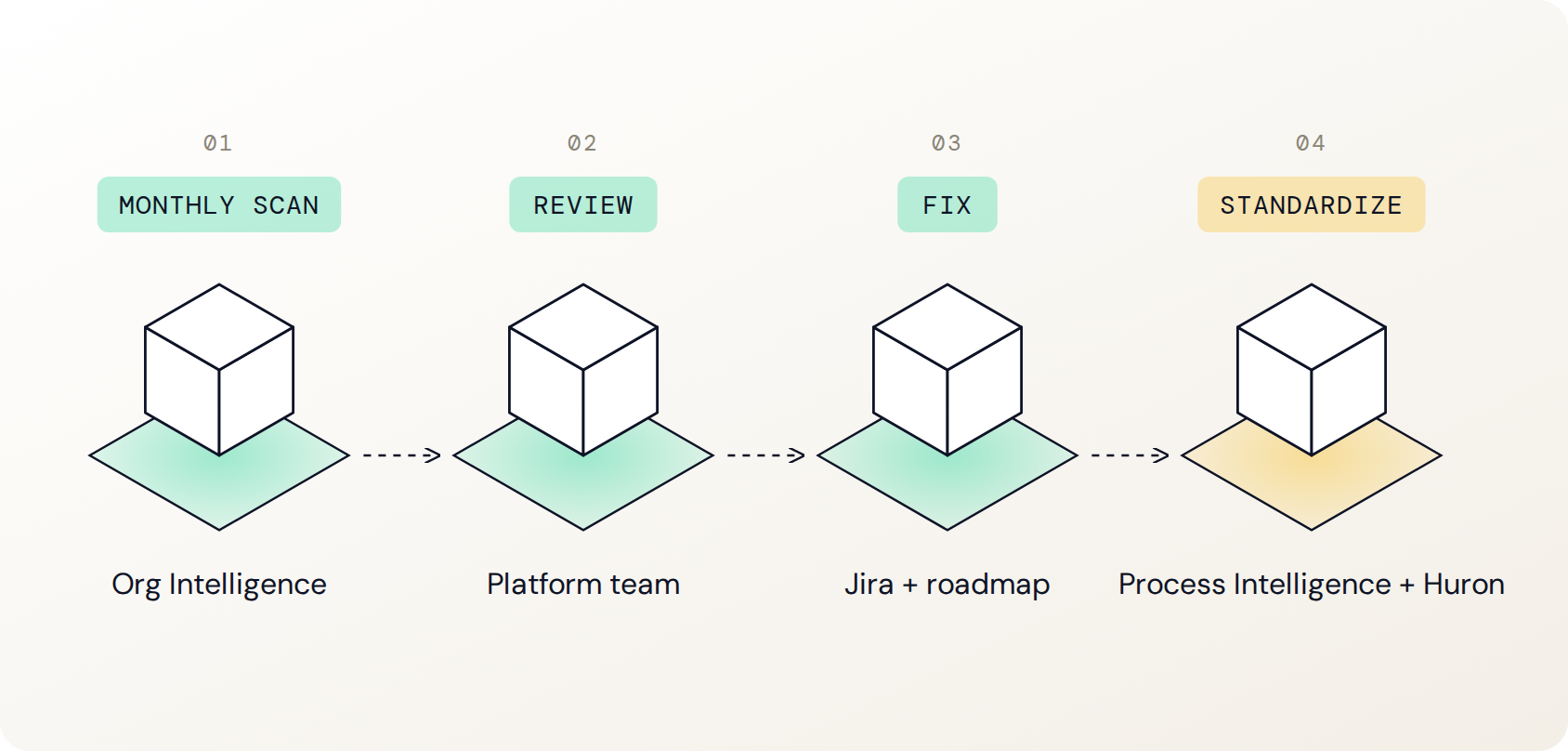
Huron introduced Hubbl Org Intelligence to Solenis before Santosh and Gagan arrived. Huron's team ran an analysis of the org and shared the results with Solenis. When the new platform team came in, Solenis and Huron agreed that Hubbl shouldn't be a one-time assessment. It should be built into how the team develops and releases.
"Together, we concluded that embedding Hubbl as a process in their SDLC would benefit the team." Peter Babalis, CRM Technical Consulting Senior Director, Huron
Today Hubbl scans the org every month, plus ad hoc scans around big projects.The team reviews the results and routes the work:
- Quick wins go straight to the team through Hubbl's Jira integration.
- Bigger initiatives, anything over 40 hours, become roadmap projects delivered with partners.
The scan results now anchor a technology roadmap the team reports against regularly.
"We're not just telling leadership what we're doing. We're giving them data, so they can see the progress the teams are making for themselves." — Santosh Asbe
That matters at Solenis, where the CIO expects numbers. Any request for budget or people comes with a commitment to show impact within 3 to 6 months.
"Having Hubbl and all those metrics has really helped us show what we've been doing." Gagan Singh
Clear measures also changed how the team works day to day. Santosh has used other org health tools across a long consulting career, and none put everything in one place. "I don't have to swivel chair between five or six different applications," he said. Clear targets give his teams direction: "When we give our teams a target that's clear, concise, and accurate, they know what needs to be done."
Simplify: less automation, cleaner objects, fewer open doors
With Hubbl's prioritized recommendations, the team started on high-impact work it could run alongside everything else.
Consolidating legacy automation. One of the first initiatives was moving Process Builders and Workflow Rules to Flow. The team didn't map them one to one. Hubbl's recommendations showed where several automations did related work, so they combined them. "We were able to combine a bunch of workflows and Process Builders into one flow," Gagan said.
Cleaning up core objects before an integration. Ahead of bringing a recently acquired business onto the platform, the team used Hubbl's field utilization data to remove fields on Account, Contact, and Opportunity that came in through old migrations and were never used. They also consolidated page layouts and duplicate pages on the same objects.
Retiring a package. A single package retirement in spring 2026 showed how much one decision can remove. Between the March and April scans:
Closing security gaps in Connected Apps. Hubbl's Connected Apps view showed how each app was used and by whom. Solenis ran a program to remove personally installed apps and eliminated most of them.
“That view gave us a lot of insight. We had better visibility into our Connected Apps, who was using them, and what we could remove.” — Santosh Asbe
The measure the team watches most closely is org complexity, because the business has told them a complex platform is harder to adopt. Over 14 months of monthly scans, the complexity score has dropped from 92 to 48, even as the business kept adding clouds and companies.
Standardize: process data shows where to fix, not what to rebuild
Cleaning up the org was one half of the problem. The other was the processes running through it. With the internal team stretched, Solenis turned to Huron again, this time to apply Hubbl Process Intelligence to case management and field service.
Case volume is high: 6,000 to 7,000 customer emails a day become cases. Huron's team assessed five case types and the service appointment lifecycle using Solenis's own Salesforce data. That included cases flowing back and forth with SAP. The finding was consistent: the core processes were healthy, and most of the friction sat in a smaller set of places.
- Intake and routing. In Customer Service, the average case took about 8 days to close, against a median of about 4, so slower outliers were pulling performance down. Cases arriving through Email-to-Case waited longer before work started.
- Reopens. In one case type, about a third of roughly 5,000 cases were reopened, and those took 2 to 3 times longer to resolve.
- Status definitions. In Orders, about 73% of records went straight from Created to Closed. The issue was statuses like Completed and Closed that didn't mean the same thing to every team, which weakened trust in reporting.
"We used Hubbl Process Intelligence to analyze actual Salesforce data and show how cases and service appointments flow in reality, highlighting delays, bottlenecks, and rework. It enables targeted improvements instead of broad process redesign." Peter Babalis, CRM Technical Consulting Senior Director, Huron
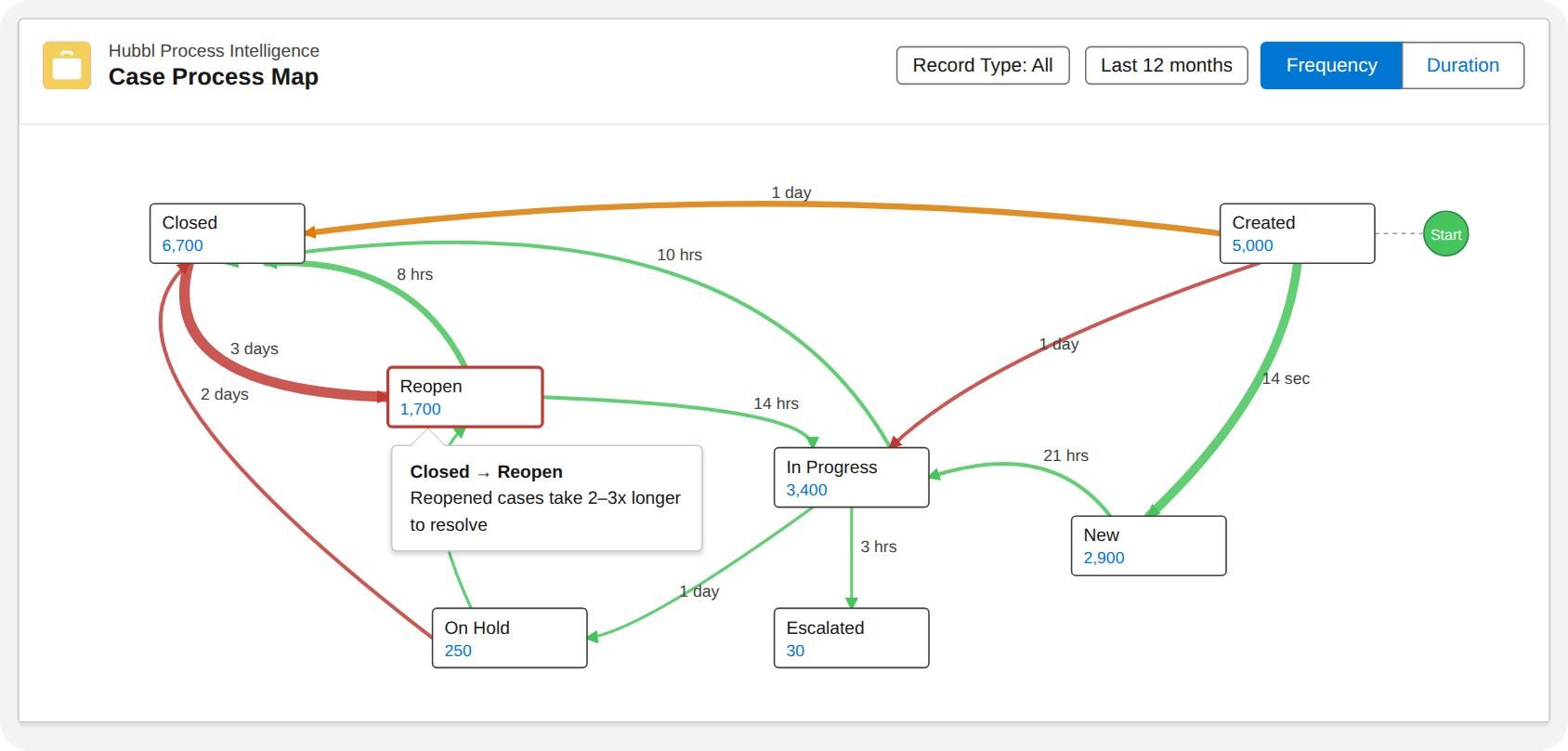
The findings gave Solenis a prioritized plan: align with the business first, then fix status governance, intake and routing, and closure quality, and add automation only once those are stable. They also support the platform team's guiding principle, to standardize globally where possible and localize only where required.
“When we go back to the business with real data and insights on our processes, we can have a much more informed discussion about where we need to improve the process.” — Santosh Asbe
What's next
Solenis isn't slowing down, which is why the team treats org health as ongoing work rather than a one-time cleanup.
"We're always running big and small projects in parallel. There are acquisitions going on, big initiatives, new clouds coming in. We can't just stop everything for one big cleanup." Gagan Singh
The next year brings a lot:
- Integrating users from recently acquired businesses in three phases, finishing by January.
- Adding Manufacturing Cloud, Marketing Cloud, and Spiff for commissions.
- Harmonizing processes across regions to cut complexity and improve adoption.
- Expanding Process Intelligence so business analysts can use it directly.
- Building a repeatable process with Hubbl's Jira integration and AI to absorb the new tech debt each acquisition brings.
“With acquisitions and new initiatives continuing, we know the platform will keep evolving. Managing technical debt therefore needs to be an ongoing process.” — Santosh Asbe
Turn the lights on. Then, fix everything.
Scan your org in 2 minutes. See what's broken, in what order to fix it — and get the prompts to do the work.