AI & Agent Optimization
Stop re-explaining your Salesforce org to AI.
Every prompt, every developer, and every agent starts by rediscovering which objects are real, which automations fire, and which fields carry data — then throws it away. Hubbl scans once, compresses the org into context an agent can act on, and serves the same current answer to every surface that asks.
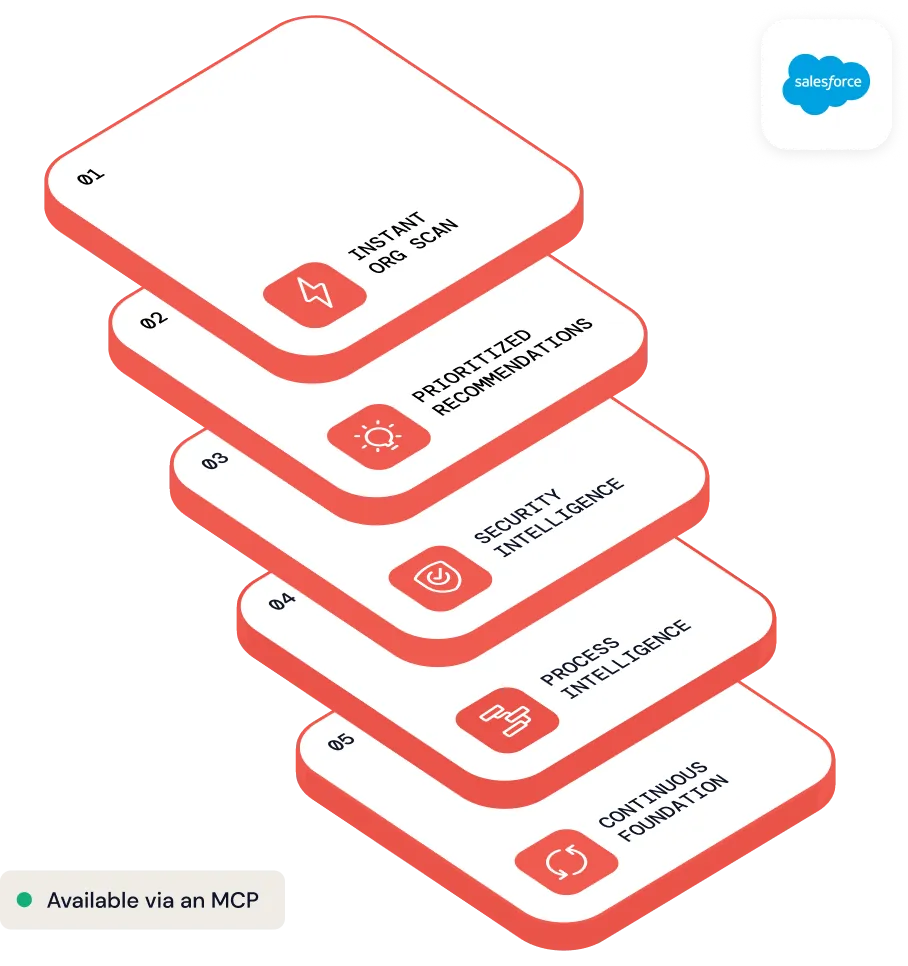
Discovery used to be a project cost. Now you pay it on every prompt.
Traditional consulting paid for org discovery once — weeks of interviews and metadata review produced a report, and the knowledge lived somewhere a person could read it. AI broke that model. Every new conversation, every new developer, and every new agent starts from zero, rediscovering which objects are real, which automations actually fire, and which fields carry data — then throws that knowledge away at the end of the session. The same questions get answered thousands of times, and the answers are discarded each time. You won't find it as a line item on any invoice — which is exactly why it keeps growing. It shows up instead as slower answers, a bill nobody can attribute, agents that need correcting, and onboarding that takes longer than anyone expected.
Ten questions answered before you get one answer.
Ask an agent something as ordinary as "can you optimize this trigger?" and it first has to establish which object it fires on, which flows and validation rules touch that object, which packages and integrations are involved, and which fields actually carry data — every time. Hubbl answers those questions once and hands the agent the result, so the work goes into the output, not into rediscovery.
- Compressed context
Business intent, architecture, dependencies, risk, and the recommended action, not raw metadata. - Fewer tokens per task
The model reasons over a bounded working set instead of re-reading the org. - Faster answers
No exploratory round-trips before the real work starts.

Agents grounded in the real org — not a plausible guess.
An agent working from residual metadata produces confidently wrong output that somebody downstream has to catch and correct. Hubbl exposes the full org model — inventory, security exposure, process map, and ranked recommendations — as structured context, so answers cite your org instead of hallucinating one.
- Structured org model
Objects, fields, flows, permissions, and dependencies as clean tool calls. - Business capability, not just schema
"Order Management," "Lead Conversion" — naming what a cluster of metadata is for improves retrieval. - Less rework
Fewer corrective loops from answers that were wrong in ways nobody noticed until later.
One shared org model. Every surface reads from it.
Hubbl scans the org once and holds the model. Instead of each tool re-deriving your org and burning tokens to relearn what Hubbl already knows, Claude, ChatGPT, Agentforce Vibes, Slack, and your own agents all read from one always-current source — so discovery is removed from every new agent you build, not just the first.
- Reusable across surfaces
The same brain for every agent and every developer. - Always current
Backed by continuous scans, never a stale export. - Time to a working agent
Knowing which objects and processes are real removes the discovery phase from every build.
The part that compounds: a memory of decisions.
Structure can eventually be derived by any scanner. Your team's decisions cannot. Without a memory of them, the same finding surfaces every session, issues your team already accepted get re-raised, false positives get re-investigated, and every new agent repeats the argument. Hubbl carries the adjudication state — so nothing gets rediscovered and re-argued.
- Already fixed
With the date and the change, so it's never re-raised. - Accepted risk
With who accepted it and why. - False positive
Recorded once, so no agent re-investigates it.
Every solution runs the same play.
No matter the role or the goal, Hubbl follows one motion — turn the lights on, understand and act, then stay clean and get AI-ready.
See the whole org
A credential-free X-ray in about two minutes — inventory, security exposure, and process reality no admin could map by hand.
Fix what matters first
A ranked backlog with the fix attached to every item — close out tech debt at the speed of AI instead of letting it pile up.
Keep it healthy
Continuous monitoring holds the line as the org evolves — and keeps the foundation ready for agents and Agentforce.
Your org already knows how it works. Your AI shouldn't have to find out again.
Point your agents at Hubbl and the discovery tax comes off the bill. Answers get faster and cheaper, output gets more accurate, new agents skip the discovery phase, and the decisions your team makes stop getting re-litigated. You spend your AI budget on outcomes, not on teaching each tool what your org contains.
- Lower cost per task - the discovery tax made countable, then removed.
- Fewer wrong answers - grounded output means less downstream rework.
- Faster time to a working agent - every build, not just the first.
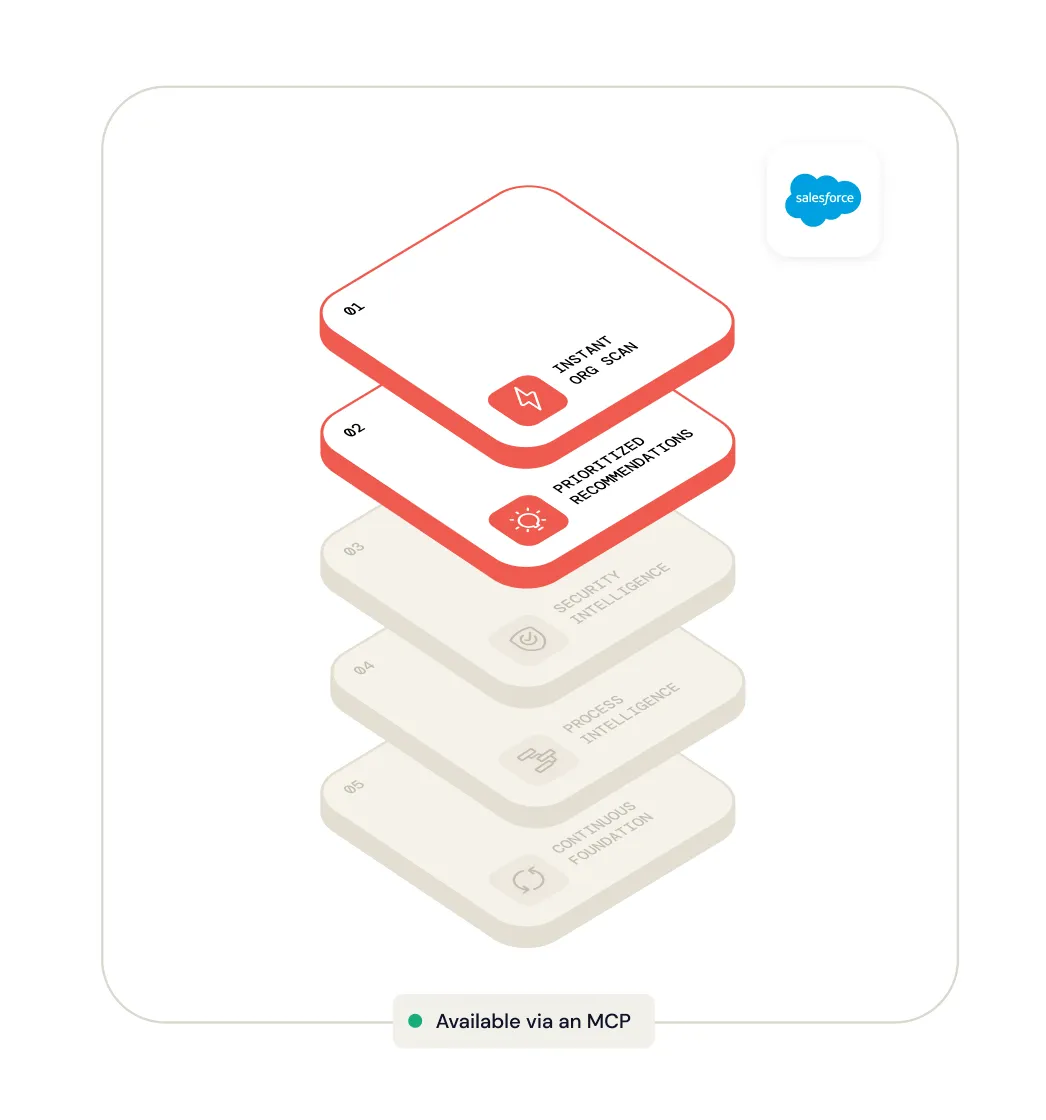
Built for the teams paying to run AI on Salesforce.
You're billed per token
"Our Claude bill keeps climbing and I can't see why."
Direct API, Bedrock, or Vertex means reducing discovery lands straight on your invoice. Hubbl removes the largest variable.
You're building many agents
"Every new agent starts by relearning the same org."
Discovery gets removed from every build — not just the first — so your team ships working agents faster.
You're standardizing AI
"Every tool has its own half-picture of our org."
One org-context layer across Claude, Vibes, Slack, and custom agents — consistent answers, no drift.
The capabilities behind the savings.
This outcome runs on the Hubbl platform — here's where to go deeper.
Hubbl MCP
The connection that hands any agent a structured, always-current model of your org.
Process intelligence
Understand how work actually moves through the org - flows, usage, and friction.
Prioritized Recommendations
The ranked fixes agents surface and act on through the MCP.
The discovery tax, made countable.
Modeled figures from the Hubbl Discovery Tax business case — verify against your own workload before publish.
40–60%
15–45%
~$109K
2 wks
Turn the lights on. Then, fix everything.
Scan your org in 2 minutes. See what's broken, in what order to fix it — and get the prompts to do the work.