Architects & Platform Owners
Change the org without breaking it.
You own the architecture of a Salesforce org that's grown for years — flows layered on flows, fields nothing reads, dependencies no diagram captures. Every change you approve carries a downstream risk you can't fully see. Hubbl maps the whole system in about two minutes, so you know exactly what a flow, field, or object touches before you ship — and can govern the platform from evidence instead of instinct.


You're accountable for a system no diagram fully describes.
The org you govern was built by many hands over many years — automations layered on automations, fields feeding fields, packages reaching into objects nobody remembers wiring up. You're the one who has to say yes or no to every change, but the dependency graph lives in tribal knowledge and stale docs, and the real risk of any edit is invisible until something downstream quietly breaks. The first job is to see the whole system — every relationship, exactly as it is right now. Hubbl draws that map in about two minutes, so architecture stops being a matter of memory and instinct and becomes something you can inspect, govern, and prove.
The dependency map no one could draw by hand.
Point Hubbl at your org and get a complete relationship graph in about two minutes — every object, field, flow, validation rule, and package, and exactly how they connect. Before you can govern a system, you have to be able to see the whole thing. This is that map, generated automatically and kept current.
- Full cross-object graph
How objects, fields, flows, and automations reference one another, in one view. - Reverse lookups
Ask "what depends on this field?" and get the real answer, instantly. - Package & automation reach
See where managed packages and flows actually touch your data model. - Always current
A live picture of the org as it is, not a diagram from two architects ago.

See what a change touches before you ship it.
The hardest part of any change isn't making it — it's knowing what else it will move. Hubbl gives you an impact preview for anything you're about to touch: the fields, flows, reports, and integrations that depend on it, so you approve changes with a documented blast radius instead of a held breath.
- Change impact preview
Everything downstream of the field, flow, or object you're about to edit. - Find orphaned metadata
Surface fields, flows, and rules nothing references, so cleanup is safe. - Catch the hidden effect
The automation two hops away that your change would quietly break. - Reviewable by design
Hand your team a blast radius they can sign off on, not a gut call.
Standards you can actually enforce.
Governance fails when it lives in a document no one reads. Hubbl turns your standards into something measurable — surfacing sprawl, duplication, and drift ranked by risk, so you can hold the line on a platform that keeps trying to grow past it.
- Sprawl, ranked
Complexity and tech debt scored by impact, so you govern the worst first. - Find duplicate automation
Overlapping flows and rules fighting to do the same job. - Drift from convention
Where naming, structure, and patterns have wandered off standard. - A governance backlog
A ranked list of what to consolidate, retire, or refactor next.
Evidence for the decisions you have to defend.
Every refactor you propose is a case you have to make — to leadership, to the admins who'll do the work, to the team that fears the change. Hubbl gives you the data behind the argument: a health score that moves, a documented before-and-after, and a shared source of truth everyone can point to instead of debating from memory.
- Org health score
Complexity, risk, and debt distilled into one number leadership understands. - Make the case with data
Quantify the risk of the status quo and the payoff of the refactor. - Trend over time
Show risk and complexity trending down as your roadmap lands. - One source of truth
A shared map devs and admins work from, so no one's guessing.
A change is a gamble without the map — and a governed decision with it.
The proposed edit your team hears as "that might break something" is the exact thing you can turn into "here's precisely what it touches." Hubbl replaces fear of the unknown dependency with a documented blast radius — so change stops being the risk everyone resists and becomes a decision you can review and defend.
"Don't touch that — it might break."
A change nobody wants to own, because the last one took down something no one saw coming. So the org calcifies and debt compounds.
"Here's exactly what it touches."
A documented blast radius — every dependent field, flow, and report — so the change ships with a reviewable plan instead of a held breath.
Why it matters for you: the changes that feel too risky to make are the ones your org needs most. Hubbl gives you the evidence to move — turning "we don't dare touch it" into "here's the plan, and here's what it affects."
Every solution runs the same play.
No matter the role or the goal, Hubbl follows one motion — turn the lights on, understand and act, then stay clean and get AI-ready.
See the whole org
A credential-free X-ray in about two minutes — inventory, security exposure, and process reality no admin could map by hand.
Fix what matters first
A ranked backlog with the fix attached to every item — ticket it, prompt it, or delegate it, and close tech debt at the speed of AI.
Keep it healthy
Continuous monitoring holds the line as the org evolves — and turns your ongoing work into a health score you can show.
From a black-box platform to a system you can change with confidence.
You stop guessing at dependencies and start governing from a live map. You know what every change will touch, where the debt is worst, and how to prove the architecture is getting better under your watch — so the org can finally evolve without breaking.
- Answer "what does this touch?" - in seconds, not a day of manual tracing.
- Ship changes with a blast radius - your team can review and sign off on.
- Govern sprawl - before it compounds — ranked by architectural risk.
Hubbl is built for the person who owns the blueprint.
You approve every change
"I'm the last line before something breaks."
Preview the full blast radius before you say yes — every dependent field, flow, and report, mapped automatically.
The org outgrew its docs
"No diagram matches what's actually live."
Get a dependency map that's always current, generated in minutes instead of reverse-engineered over weeks.
Tech debt keeps compounding
"Sprawl grows faster than we can govern it."
Work a governance backlog ranked by architectural risk, with the fix attached to every item.
The capabilities behind your solution.
Your role runs on the same platform — here's where to go deeper.
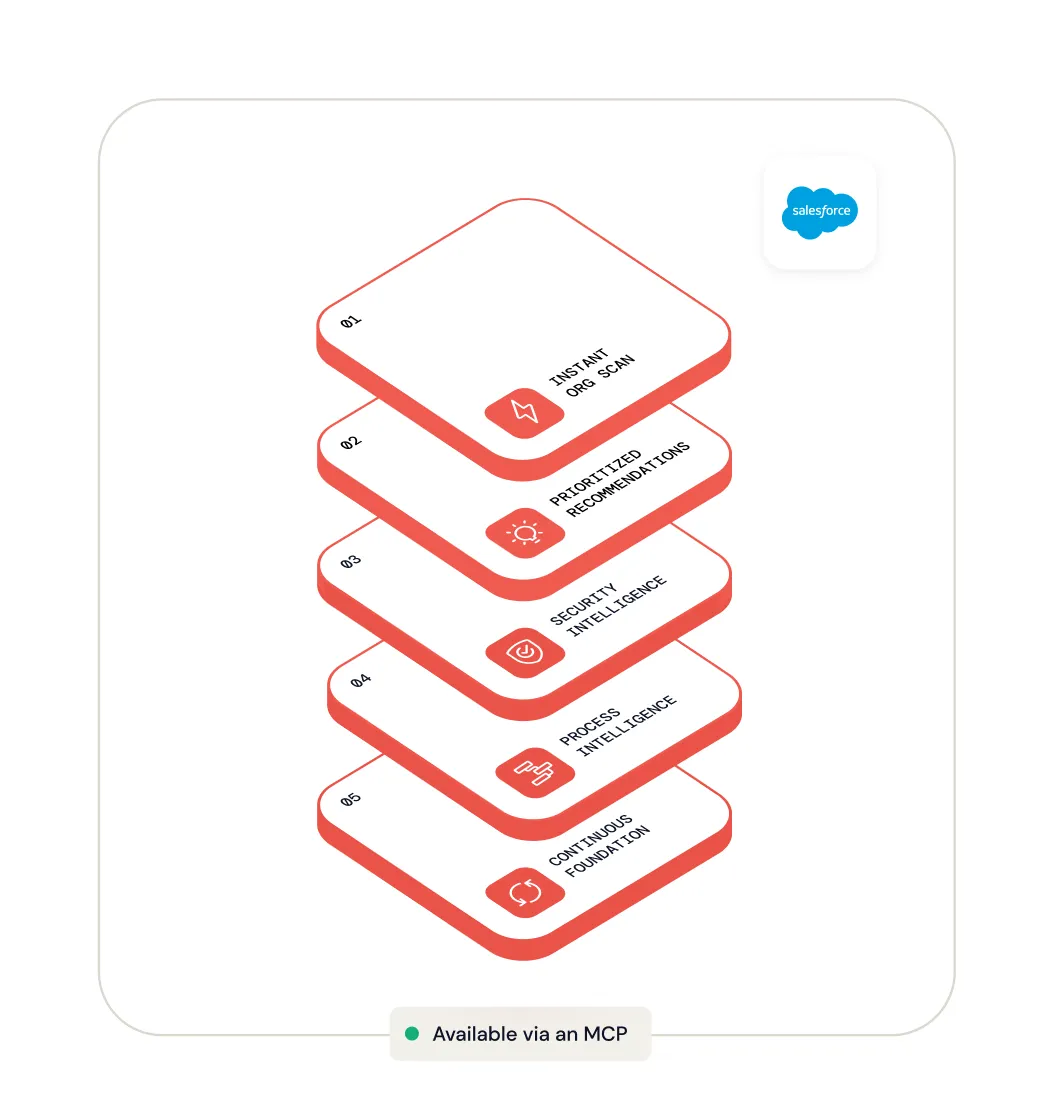
Instant Org Scan
The two-minute X-ray that maps every object, field, flow, and dependency — the foundation for everything above.
Process intelligence
Flows, automations, and usage mapped — see what fires, what overlaps, and where the system fights itself.
Prioritized Recommendations
A governance backlog ranked by impact, with ready-to-run fix prompts and Jira-ready detail on every item.
Architects ship faster when they can see every dependency.
Refactor, retire, and redesign with a full picture of what depends on what.
2 min
6,368
100%
4.8/5
Turn the lights on. Then, fix everything.
Scan your org in 2 minutes. See what's broken, in what order to fix it — and get the prompts to do the work.