"Let's prove it": How Certinia answers customer org questions with facts
orgs scanned
About 1 hour
to assess a customer org (was 2 to 3 weeks);
3 days
to pinpoint issues behind cases open close to a year;
2x
customer confidence, by Bryan’s estimate
Every Salesforce ISV knows the escalation call. A customer's org is misbehaving, your managed package sits somewhere in the middle of it, and nobody can say for sure whose code is at fault. Certinia, which builds financial management and professional services automation (PSA) software natively on Salesforce, used to spend weeks answering that question.
Bryan Miller, who leads Global Technical Success at Certinia, changed that. His team pairs Hubbl org scans with an AI agent they built themselves. An assessment that once took weeks of discovery meetings now starts with a scan that runs in about an hour. More than 20 people across the company can run it, and customers get recommendations backed by data instead of opinion.
The part of the org no vendor can see
Bryan's 12-person team spans the UK, US, and Asia and supports Certinia's largest customers. Together they bring more than 100 years of combined experience with Certinia's products. What they couldn't see was everything around those products: the custom Apex, the flows, the partner-built solutions, and the years of changes that pile up in any enterprise org.
When a customer escalated, the team had no fast way to tell whether the problem started in Certinia's packages or in everything built around them.
"When customers would escalate a technical issue, we were essentially blind to the org." Bryan Miller, Global Technical Success, Certinia
So the team asked for a reverse demo, a walkthrough of the org led by the customer's own admins. Then they asked for another with the business stakeholders. A single investigation could take 4 to 6 hours of meetings and 2 to 3 weeks of prep before anyone could recommend a fix.
Upgrades stalled for the same reason. Certinia ships new releases, but customers decide when to take them, and a heavily customized org makes that decision feel risky. "They'd be scared to do upgrades asking, 'Well, how custom am I, and what's going to break?'" Bryan says. "We'd say, 'I don't know. Let's have seven meetings and talk about it.'"
Product telemetry showed the team which Certinia features customers used. It couldn't show where platform automation, custom code, partner builds, and Certinia's managed packages ran into each other. And many enterprise customers, reasonably, don't give a vendor direct access to their org.
From one scan to a new habit
Bryan ran Certinia's first Hubbl scan in September 2024, after a Certinia sales leader made the introduction.
The scan runs on the customer's terms. The customer starts it, it works within their existing logins and permission sets, and Certinia never needs direct access to the org. That made scans easy for customers to approve. And for the first time, Bryan's team could see what was connected to what.
It also gave the team a better answer to a line they'd heard for years: "We can't upgrade. We're too complex. We're too unique." "Interesting," Bryan would say. "Let's prove it!"
Bryan started sharing what the scans showed, and other teams asked for the same thing. Today more than 20 people across technical success, support, technical account management, and professional services run Hubbl scans.
Scan first, then let the agent do the reading
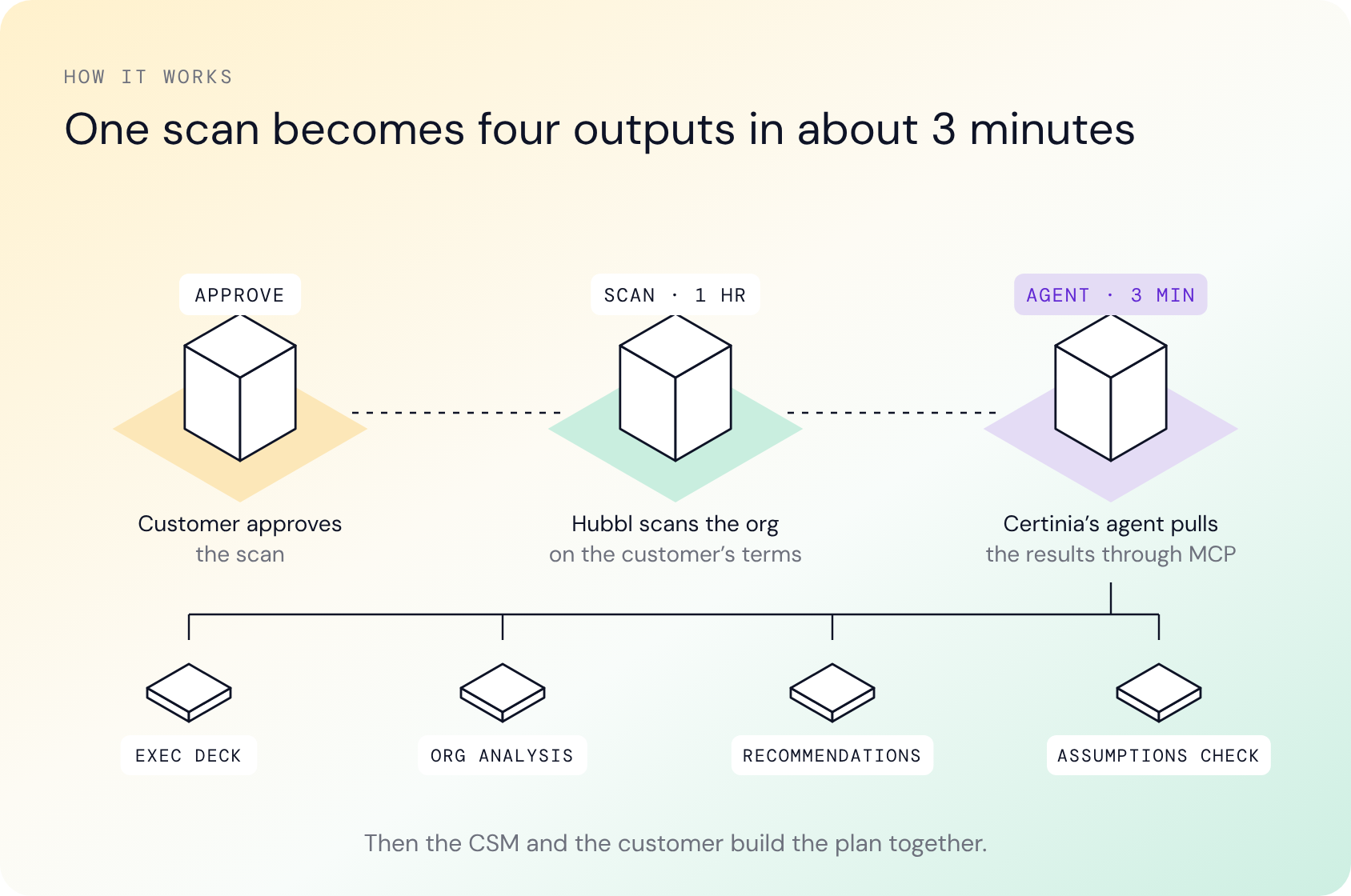
Every adoption check now starts with a scan. Once the customer approves it, the scan finishes in about an hour.
Then the team's AI agent takes over. It connects to Hubbl through MCP, pulls the scan results, and reads them against everything Bryan's team knows about Certinia's products. About 3 minutes later, it delivers four documents: an executive deck for leaders, an analysis of what's happening and why it matters, technical recommendations for admins and developers, and an internal document that challenges the team's own assumptions.
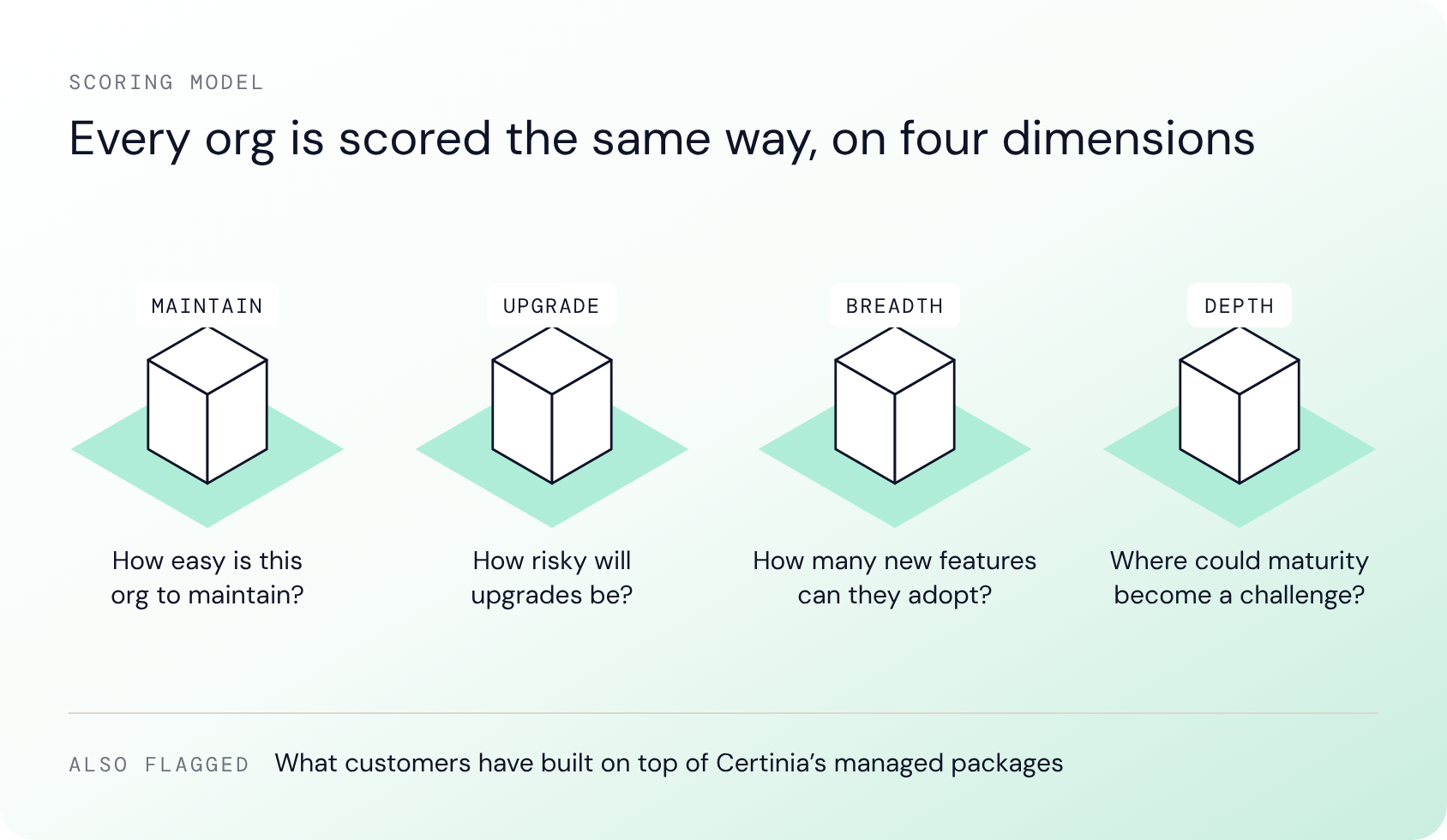
The agent scores every org the same way: how easy it is to maintain, how risky it is to upgrade, and how much further the customer can go on breadth and depth of adoption. It also flags what customers have built on top of Certinia's managed packages, separating what could cause trouble from what duplicates functionality the packages already include.
A second tool compares each scan with every org the team has scanned before. That lets them check a result against orgs of similar size and complexity and keep their scoring consistent over time.
The result is a team that's no longer the bottleneck. Bryan's group used to handle about 5 assessments a week. Now anyone at Certinia can get the same assessment when they need it: a pre-sales check on whether an install will go cleanly, a support engineer chasing an escalation, or a CSM reviewing an org after go-live.
"They get to carry all 12 of my people and all 100-plus years of our experience with Certinia products into any conversation."
What changes when the data does the talking
Speed matters. But Bryan points to a bigger change: customers trust the team's recommendations more.
"We're recommending not just on our historical knowledge and our tribal instinct. We have objective data that we can point to, which really creates that trusted advisor status with our customers."
12-plus releases behind, now almost current
Version debt gets close attention at Certinia. Customers who fall more than about four releases behind are at higher risk of leaving, and they miss out on everything Certinia has shipped since.
One clinical research organization had never upgraded since buying Certinia's products. It was 12 to 14 releases behind, and every quarter the upgrade moved to the next one. When executives finally pushed, the customer's team named what was holding them back: three flows and three pieces of Apex that nobody wanted to touch.
Bryan's team scanned the org and walked the customer through exactly what those components did, what they connected to, and what needed testing. They offered to review the test scripts too. With the risk mapped, the customer started the upgrade. It's now in the second phase, one step from the current release.
A year of open cases, narrowed down in 3 days
Another customer, a name most of the Salesforce community would recognize, had layered automation on top of automation for years without retiring the old layers. A set of support cases had stayed open for close to a year, with executive escalations, because no one could find where the problem lived.
Hubbl changed that. Within about 3 days, Bryan's team had narrowed the problem to specific areas of the org. Developers pulled debug logs in exactly those spots and confirmed the issue sat in the customer's own automation. The customer is now refactoring it.
From "this is a mess" to a plan
Then there's the inherited org, a situation every Salesforce admin knows. A customer's new primary contact took over three orgs at once and told Bryan, "This is a mess. I don't know what's going on."
After the scans, she knew where everything lived and why each automation existed, including the ones she wanted gone. For Bryan, that shift is the point.
"If I would put a number on it, the confidence level goes from a four to an eight. They don't always like the answer, but less the point. The objective is to give them the information and then for us to craft a plan together."
Three Certinia customers are working through action plans right now as a direct result of Hubbl Org Intelligence, including retiring automations built for parts of their business that no longer exist.
Next: scan before, during, and after
Bryan wants Certinia's largest customers on a recurring scan schedule tied to their adoption plans. When a customer rolls out new features, the team will scan before, during, and after, so everyone can see exactly what changed in the org.
He's also bringing scan data into Slack, alongside Certinia's product telemetry. In a quarterly business review, when a customer says their goals have shifted, a CSM won't have to promise a follow-up. They'll be able to check where the org is complex in that area, spot features the customer pays for but underuses, and book a technical success session on the spot.
Would he give it up?
We asked Bryan what he'd say if leadership told him to cut Hubbl.
"That would be like being told 'I need you to get from New York to L.A. by tomorrow, but you have to walk, in the rain, wearing a fur coat.' Hubbl is materially impactful in our ability to translate objective telemetry from product into actionable data with a customer." Bryan Miller, Global Technical Success, Certinia
Turn the lights on. Then, fix everything.
Scan your org in 2 minutes. See what's broken, in what order to fix it — and get the prompts to do the work.