.png)
Something interesting has been happening in our customer pipeline over the past several months. We've been seeing a distinct pattern in the organizations choosing to adopt Hubbl: many of them are companies with a deep, formal commitment to Kaizen. Not organizations that have heard of continuous improvement and nod along at conferences, but companies where Kaizen is genuinely embedded in the operating culture. Where practitioners hold certifications. Where improvement cycles are a standing item on the leadership agenda. Where waste isn't tolerated, it's hunted.
These organizations aren't coming to us by accident. They're coming to us because they recognize something the rest of the market is still catching up to: Kaizen and Salesforce management are, at their core, the same discipline. And Hubbl is the platform that finally makes that connection explicit.
Here's why I believe that, and why the story of how we built Hubbl makes it feel less like a business insight and more like an obvious truth the market is only now catching up to.
Salesforce is the operational backbone of modern business. It's where deals get closed, customers get served, and revenue gets recorded. For many organizations, it is the business process, the place where your strategy either succeeds or quietly fails, one record at a time.
In Kaizen, there is a word for this place: gemba (現場), Japanese for "the actual place" where value-creating work happens. On a factory floor, the gemba is the assembly line. In a hospital, it's the ward. The foundational Kaizen principle of "going to the gemba" means that leaders must observe work as it actually happens, not from reports, not from summaries, not from assumptions made in a conference room. Reality lives in the gemba. Improvement begins there.
For modern businesses, Salesforce is the digital gemba. It is the actual place where your revenue processes live and breathe. And in Kaizen, going to the gemba has always begun with the same foundational tool: a value stream map, a complete picture of how work actually flows from one step to the next, where it slows, where it stops, and where it breaks down entirely. We'll come back to that, because it turns out to be one of the most powerful things Hubbl does.
And here is the problem that almost no one talks about openly: most leaders have never been there.
They manage their Salesforce org from dashboards, from anecdote, from quarterly business reviews. They rely on what their Salesforce product owner tells them, filtered through whatever that person thinks leadership wants to hear, summarized into a slide deck that bears only a passing resemblance to what is actually happening inside the system. The executive sees a pipeline number. The board sees a forecast. Neither sees the tangled automations underneath, the fields that nobody fills in, the security holes, the processes that exist in documentation but not in practice.
This is the gap that has defined the relationship between Salesforce and the C-suite for as long as the platform has existed. The Salesforce product owner knows things the board will never see, and the board makes decisions the product owner can't fully influence. There has never been a shared language. There has never been a shared view of reality. The product owner lives at the gemba. Leadership lives in the conference room. And the distance between those two places costs organizations more than most of them will ever measure.
Kaizen has a name for what fills that gap: organizational intelligence. And creating it, continuously and objectively at every level of the organization, is precisely what Hubbl was built to do.
Meanwhile, at the technical level, the org itself tells a familiar story. Metadata accumulates unchecked. Automations layer on top of automations. Fields get created, forgotten, and duplicated. Workflows built for a business model three years ago still run silently in the background, burning compute, slowing user experience and introducing risk. Security gaps appear at the edges of connected apps no one remembers approving.
A Kaizen practitioner would immediately recognize this for what it is: muda, the Japanese term for waste. Hidden, systemic, compounding waste that doesn't announce itself; it just quietly erodes efficiency, agility, and trust in the system.
The traditional response has been the manual org audit, weeks of painstaking discovery, Salesforce admin hours, consultant engagements, and spreadsheets that are out of date before they're finished. For most organizations, that means the audit happens once, maybe twice a year as a form of annual technical health review. And then the org drifts again.
That is the opposite of Kaizen.
At its core, Kaizen demands three things that are non-negotiable.
VISIBILITY INTO THE CURRENT STATE: not what you assume, not what was documented two years ago, but what is actually happening right now.
A RELIABLE FEEDBACK LOOP: It must be continuous rather than episodic. Improvement that happens once a year isn't improvement; it's damage control.
SHARED UNDERSTANDING ACROSS THEM TEAM: Kaizen is not a top-down initiative. It requires everyone, from the practitioner on the floor to the executive sponsor, to be operating from the same picture of reality.
For years, achieving all three of these inside a Salesforce org required either massive manual effort or just hoping for the best. We built Hubbl because we believed that wasn't good enough. And frankly, for organizations that take operational excellence seriously, it never was.
I spent the early part of my career as an analytical chemist. Before I ever worked in the Salesforce ecosystem, I spent years in a laboratory doing something that, in retrospect, was pure Kaizen: observing systems, measuring them precisely, forming hypotheses about why they behaved the way they did, testing those hypotheses, and refining my understanding iteratively until I could act on it with confidence.
That process has a name in science. It's called the scientific method. And it turns out it has a name in operations management too: PDCA, which stands for Plan, Do, Check, Act. They are, at their logical core, the same thing. Both rest on a single conviction: reality is knowable if you measure it carefully enough, and improvement is achievable if you're honest about the gap between where you are and where you want to be.
When I moved into the Salesforce ecosystem, I brought that conviction with me. As a consulting solution engineer working on hundreds of Salesforce orgs, what I saw was a platform sitting at the center of modern business operations, the place where revenue processes lived and executed, with no precision instrument to measure it. Organizations were managing their most critical business system on instinct, anecdote, and annual audits. For someone trained to believe that you cannot improve what you cannot measure, that gap was impossible to ignore.
I also noticed that there were no standards. In analytical chemistry, the certified reference material enables scientists to make measurements and decisions based on existing benchmarks. This gap in the Salesforce systems means many businesses are making decisions blindly or relying on expensive and incomplete advice. It was clear that the Salesforce ecosystem needed reliable benchmarks and a way to measure one’s organization(s) against them, so we built it.
That is what Hubbl is, at its foundation: a precision measurement instrument for your Salesforce org. Not a reporting tool. Not a dashboard. An instrument that tells you what is actually happening in your system, continuously, with enough granularity to act on and the power to communicate its context easily to both humans and AI. The same way an analytical chemist doesn't guess at what's in a compound, a Hubbl-powered organization doesn't guess at the state of its Salesforce environment. It measures. It knows. And then it improves.
Think of Hubbl as your permanent gemba presence inside Salesforce, a continuous, instrumented view of the actual place where your business processes execute, available not just to the admin who manages it but to every stakeholder who should understand it.
This is the shift that matters most for organizations that don't yet think of themselves as Kaizen practitioners. Hubbl doesn't just give your technical team better data. It gives your entire organization, from product owner to CFO, a shared, objective picture of reality that has never existed before. The conference room and the gemba finally see the same thing.
Hubbl Org Intelligence gives your team a continuous, real-time picture of your Salesforce environment's health, covering metadata cleanliness, automation complexity, security posture, adoption, and technical debt, all benchmarked against thousands of other organizations. You don't have to guess whether your org is in good shape. You know. And you know exactly where the problems are ranked by business impact, so you can prioritize your improvement efforts with data instead of instinct.
For anyone with a Kaizen mindset, this is the equivalent of a live value stream map of your entire Salesforce org, always current, always honest, never filtered through someone's memory of how they think it was set up. For an executive or board member, it's something even simpler and more powerful: the first honest answer they've ever had to the question of how their Salesforce is actually performing.
Hubbl Process Intelligence goes a layer deeper. It maps how your processes actually run, not how they were designed to run, not how the documentation says they run, but the real behavioral flow of data and users through your Salesforce workflows. It surfaces the bottlenecks, the process variants, the divergences between your ideal state and your actual state. It tells you where work gets stuck, where volume spikes, where your teams have quietly built workarounds because the process wasn't working for them.
This is the Kaizen practitioner's native language, translated into the digital reality of your CRM. And for the Salesforce product owner who has spent years trying to explain to leadership why certain things aren't working, it's finally a language that executives can read too.
In Kaizen, value stream mapping is one of the most powerful tools a practitioner has. The premise is deceptively simple: document every step in a process, including the handoffs, the wait times, and the steps that add no value at all, and suddenly the waste that was invisible becomes impossible to ignore. A process that felt reasonably efficient reveals itself to be 60% non-value-adding activity. A handoff that seemed instantaneous turns out to be where work sits for three days. The map doesn't just show you the process. It shows you the truth about the process, including the activities related to it.
The problem is that doing this inside a Salesforce org, by hand, is extraordinarily difficult.
Your Salesforce environment isn't a single process. It's dozens of interconnected processes running simultaneously across multiple objects, multiple teams, and multiple automation layers. To value stream map a lead-to-opportunity conversion manually, you'd need to trace every field, every workflow rule, every validation rule, every assignment rule, every piece of automation that touches that record along the way. Then you'd need to layer on the human behavior: which fields are actually being filled in, which steps are being skipped, where reps are creating unofficial workarounds. Then you'd need to do it again next quarter to see what changed.
Most organizations never attempt it. The ones that do spend weeks on it and end up with a snapshot that's already out of date before the workshop is finished.
Hubbl's Process Intelligence changes the nature of this problem entirely. Rather than a manual exercise conducted periodically by a small team with access to a whiteboard, value stream mapping in Hubbl is automatic, continuous, and available to everyone. Easily generate a fresh map of how your processes are actually running, surfacing bottlenecks, process variants, and divergences between designed and actual flow in minutes rather than weeks.
But the most valuable dimension isn't the speed. It's the behavioral layer. A traditional value stream map shows you what the process is designed to do. Hubbl's version shows you what people are actually doing inside it, including which steps generate friction, which fields get skipped, where workarounds have been quietly institutionalized because the designed process doesn't match the reality of the work. That's not just a map of the process. That's a map of where the process is failing its users, and by extension, where your next Kaizen intervention should focus.
For a Center of Excellence managing multiple orgs, the value compounds further still. Instead of value stream mapping each org independently and then trying to reconcile the results across a spreadsheet, Hubbl gives you a consistent, comparable view of process flows across your entire portfolio. You can see at a glance which orgs have rationalized their lead qualification process and which are running five different variants of it. You can identify the cleanest process in the portfolio and use it as the standard to migrate toward. You can map the current state of every org simultaneously, which is the prerequisite for designing a coherent future state across all of them.
In Kaizen, you map before you improve. Hubbl makes the map. And then it keeps it current.
Here's where I think the alignment between Kaizen methodology and Hubbl's platform becomes genuinely exciting.
The PDCA cycle is the engine of continuous improvement. But the speed of that cycle is determined by the speed of the Check phase. How quickly can you observe the results of a change? How accurately? How completely?
In a traditional Salesforce environment, the Check phase is painfully slow. You make a change, and then you wait, for adoption data to accumulate, for issues to surface in support tickets, for someone to notice something is off. By the time you're acting, you've lost weeks or months of improvement cycles.
Hubbl compresses that timeline dramatically. Our platform provides near-instant feedback on the health and behavior of your Salesforce org. When you implement a process change, you can monitor its adoption, its downstream effects, and any new inefficiencies it introduces in real time. That means your PDCA cycles can run faster, your improvements can compound more quickly, and your organization can stay ahead of the entropy that naturally accumulates in any complex system.
For Kaizen practitioners, this isn't just a productivity gain. It's a philosophical shift from periodic improvement to genuinely continuous improvement.
For engineering and technical teams, there's a layer deeper still. Hubbl exposes its intelligence via API and MCP, which means the org health and process data Hubbl surfaces can be piped directly into the AI-assisted development environment of your team's choice. Think of what that makes possible: your Hubbl scan runs, identifies technical debt, flags underperforming automations, surfaces metadata that needs refactoring, and that intelligence flows directly into an AI coding assistant as structured, pre-contextualized input. The developer doesn't start from a blank prompt trying to explain the problem. The problem is already described, already prioritized, already understood. The AI can act on it immediately.
What this creates, in Kaizen terms, is a continuous code refactoring cycle, one where the Check phase and the Act phase are connected programmatically rather than separated by a human handoff. Hubbl even ships pre-built AI prompts designed to accelerate common improvement patterns, so teams aren't reinventing the wheel on every cycle. They're building on a library of structured improvement intelligence that gets sharper over time.
For a Kaizen practitioner who has spent years trying to tighten the gap between identifying a problem and resolving it, this is what that looks like at the speed of software. The improvement loop doesn't just run faster. It runs continuously, with AI as a participant in every cycle.
Here's a distinction worth drawing sharply, because I think it's one of the most important things to understand about Hubbl and about what Kaizen in a Salesforce context actually means.
Most Salesforce monitoring tools are built to answer technical questions. Is the org healthy? Is the automation running? Are there security risks? Those questions matter. But they're not enough. Because a technically clean Salesforce org can still be a failing one if your people aren't actually using it the way it was designed.
This is the adoption problem. And it is, at its core, a Kaizen problem.
When you roll out a new process in Salesforce, a redesigned opportunity stage, a new case management workflow, a change to how accounts are qualified, how do you know if it's actually being followed? In a physical operation, you walk the floor. You watch. You count. You measure. In Salesforce, without the right intelligence, you're largely guessing.
The Hubbl platform changes that through field utilization tracking across every single field in your org over time. Every field in your Salesforce org is either being populated or it isn't. That utilization rate is a direct signal about whether your business process is being followed. If a field that's supposed to capture a critical qualification criterion is sitting empty 70% of the time, that's not a data quality problem. That's a process adoption problem. And a Kaizen practitioner knows exactly what to do with that information: investigate, understand the root cause, adjust the process or the training, and monitor the improvement.
Hubbl surfaces this data not as a one-time snapshot but as a trackable trend. Kaizen practitioners schedule weekly or monthly scans and watch field utilization move over time, watching adoption rates climb after a training intervention, catching new drops that signal process drift, building a longitudinal picture of organizational behavior that no other platform in the Salesforce ecosystem provides.
The same logic applies to login activity and license utilization. If a portion of your licensed users aren't logging in, that's waste, pure and simple. And it raises harder questions. Is the tool working for them? Are there process barriers preventing engagement? Are your change management efforts landing? Hubbl makes the utilization picture visible so you can ask those questions with data behind you, not assumptions.
And then there's active record engagement, tracking not just who's logging in but who's actually updating records across objects. A user can log in and do nothing meaningful. Hubbl distinguishes between presence and participation, giving you a granular view of how your teams are genuinely interacting with the business processes you've built.
Together, these signals form what I'd call behavioral intelligence for your Salesforce org. Not just "is the technology working?" but "are our people working the process?", which is the question Kaizen has always been fundamentally about.
There's a quiet failure mode that undermines Kaizen initiatives in almost every organization that attempts them: the intelligence stays with one person. The admin who ran the audit. The consultant who did the discovery. The ops leader who built the dashboard. When the insights live in one person's head or one person's spreadsheet, they don't drive organizational change. They drive a to-do list for one person, and then that person moves on.
This is why one of the most deliberate decisions we made in building Hubbl was to offer unlimited users on every plan.
That might sound like a commercial decision. It isn't. It's a Kaizen decision.
Kaizen's third non-negotiable, shared understanding across the team, cannot be achieved if access to intelligence is rationed. When your Salesforce admin, your revenue operations leader, your sales manager, your IT director, and your executive sponsor are all looking at the same picture of org health and process adoption, something different happens. Conversations change. Decisions get made faster. Accountability becomes shared rather than siloed. The improvement culture that Kaizen demands becomes possible because everyone is operating from the same reality.
With Hubbl, there's no reason to limit who sees the data. Your whole team, across functions, across seniority levels, across the business, can access the same org intelligence, the same adoption trends, the same process maps. A sales manager can see whether her team is following the qualification process. A CFO can see license utilization before a renewal decision. A change management lead can track field adoption week over week after a training rollout, without waiting for an admin to pull a report. New team members are onboarded faster.
This is what shared understanding looks like in practice. And it's the difference between Kaizen as a philosophy and Kaizen as a functioning operating system for your business.
Everything I've described so far applies to a single Salesforce org. But some of the most compelling Kaizen use cases we see with Hubbl happen at a different scale entirely, across the enterprise, where a Salesforce Center of Excellence is responsible not for one org but for many.
This is the reality for large, complex organizations: holding companies with multiple operating companies, enterprises that have grown through acquisition, or global businesses running regional Salesforce instances that have evolved independently over years. Each org has its own metadata patterns, its own automation approaches, its own process variants, its own technical debt. The Center of Excellence sitting above them is trying to impose order, standardization, and governance across all of it, often with incomplete visibility into any one of them, let alone the full portfolio.
For a Kaizen practitioner leading or supporting a Center of Excellence, this is the problem at its most complex. You're not just doing value stream mapping for one process. You're trying to rationalize an entire landscape of processes, apps, and organizational behaviors that have diverged over time. Hubbl was built to work at this scale.
Multi-org monitoring gives a Center of Excellence a simultaneous, consistent view of health and adoption across every org in the portfolio, the same intelligence layer applied uniformly, so you're not comparing apples to oranges when you look across your operating companies. Instead of each org being a black box that requires its own manual discovery engagement, every org becomes legible through the same framework. Technical debt, field utilization, process adoption, security posture, license efficiency, all visible, all comparable, all tracked over time.
This changes the nature of the Center of Excellence's work in three meaningful ways. Org consolidation and merger decisions become data-driven, giving leaders an objective side-by-side picture of complexity, overlapping processes, and relative health in minutes rather than months. Process migration and standardization become intentional rather than imposed, because you can see exactly where a process will migrate cleanly and where it will require significant adaptation. This way governance becomes proactive rather than reactive, because when an org drifts, the Center of Excellence sees it immediately rather than in the next quarterly review.
We all know that not every business managing a multi-org environment has a Center of Excellence. In many of the conversations I’ve had with customers this is often a goal and they are looking for the first step to take toward a governance structure. Taking a few minutes to begin monitoring their portfolio of orgs is often the first step toward that governance framework.
For the Salesforce leader who has spent years trying to bring order to a fragmented org landscape, Hubbl is not just a monitoring tool. It's the intelligence infrastructure that makes enterprise-scale Kaizen possible.
Hubbl is not a tool you use once to clean up your org and then set aside. That would be like doing a single Kaizen event and declaring victory. Any practitioner worth their credentials knows that's not how it works.
Hubbl is a discipline. A practice. A commitment to maintaining organizational intelligence about your Salesforce environment the same way a Kaizen organization maintains operational intelligence about its manufacturing floor. The value compounds over time as your benchmarks improve, your team builds fluency with the data, and your Salesforce org becomes progressively cleaner, faster, and more aligned with the way your business actually needs to work.
The organizations that get the most out of Hubbl are the ones that treat it the way they treat Kaizen itself, not as a project, but as a posture. A permanent commitment to knowing more, seeing more, and improving more than they did yesterday.
There is a principle in analytical chemistry that I carried with me into the Salesforce world and that sits at the foundation of how Hubbl was designed: a measurement that gives you a different result every time you run it isn't a measurement. It's noise.
The entire scientific method, and by extension the entire Kaizen improvement cycle, depends on measurement integrity. When you run a PDCA cycle and arrive at the Check phase, you need to be able to trust that the difference between your baseline reading and your current reading reflects a real change in the system. Not a change in the instrument. Not a different interpretation by a different analyst. Not a shift in how the question was framed. A real change, in the real system, that you can act on with confidence.
This is what Kaizen practitioners mean when they talk about measurement integrity, and it's the quiet reason why so much Salesforce intelligence fails to drive genuine improvement.
Most of the insight organizations get about their Salesforce orgs today is non-deterministic by nature. A consultant produces an assessment. Six months later a different consultant produces a different one. An AI tool analyzes the org and generates insights, but run it again tomorrow and the framing shifts, the priorities reorder, the language changes. You cannot tell whether your org improved or whether the instrument simply gave you a different reading. For a Kaizen practitioner trying to close a PDCA loop, this is a foundational problem: you cannot measure improvement against a baseline that moves.
Hubbl was built to be deterministic in a way that Kaizen practitioners will immediately recognize as correct. Within any given scoring model, when you scan your org today and scan it again in thirty days, the delta is real. The methodology didn't shift overnight. The benchmarks are stable and consistent across thousands of organizations. What moved is your org, and you can trust that signal completely.
But here is where we part ways with the idea that a good instrument never changes. A scoring model that never evolves is its own form of waste. The Salesforce ecosystem changes. New optimization opportunities emerge. New risks appear. Kaizen itself demands that the instrument improve alongside the system it measures, and Hubbl's scoring model does exactly that.
The difference between Hubbl's evolution and the non-deterministic noise of AI-generated assessments is transparency. When Hubbl updates its scoring methodology, customers are notified explicitly, told which model version is being applied, and given the context to understand what changed and why. That means a shift in your score can always be interpreted correctly: did your org improve, or did the methodology evolve? You always know. You never have to guess.
For a Kaizen practitioner, this is the right design. Standards should be stable enough to measure against and honest enough to improve when the world changes. What they must never do is shift silently, without notice, in ways that make the data untrustworthy. That is the failure mode Hubbl was built to prevent, and transparent versioning is how we prevent it.
But there is a second dimension to this that matters just as much: scalable, institutional knowledge.
AI-generated insights are, by definition, personal to the moment. They reflect the model's interpretation of your specific context at a specific point in time. They don't accumulate. They don't transfer. Every new person who queries the AI gets a slightly different answer, which means your organization never actually builds shared understanding. It builds a collection of individually generated interpretations that diverge the moment two people compare notes.
Hubbl's deterministic approach means the knowledge is organizational, not individual. The same scan, the same scoring, the same benchmarks, available to every user, across every team, at every level of the organization, every time. A new Center of Excellence leader stepping into a role doesn't have to rebuild understanding from scratch. A CFO asking about org health gets the same answer the admin would give, because they are both reading the same instrument. A Salesforce product owner presenting to the board doesn't have to translate or filter. The data speaks the same language to everyone in the room.
This is what Kaizen means by shared understanding at its most rigorous: not that everyone has been briefed on the same slide deck, but that everyone is looking at the same objective, repeatable, trustworthy view of reality. No interpretation required. No variance between readings. No wondering whether the insight you got today will hold tomorrow.
In a world where AI is generating more and more of the intelligence organizations rely on, the organizations that maintain a deterministic foundation will have a profound and compounding advantage. Their improvement cycles will be anchored to reality in a way that AI-only approaches simply cannot match.
Kaizen has always known this. The instrument has to be trustworthy before the improvement can be real.
I want to close the technical argument with what I think is the most important observation in this entire piece, and the one that most directly explains why Kaizen organizations are gravitating toward Hubbl right now, at this particular moment in the Salesforce ecosystem.
We are entering the agentic era.
Agentforce, Salesforce's AI agent platform, is not a feature. It is a fundamental shift in how Salesforce works. Instead of users navigating Salesforce to complete tasks, AI agents will increasingly complete those tasks autonomously: qualifying leads, resolving cases, updating records, triggering workflows, making decisions. The potential is enormous. The risk, for organizations that aren't prepared, is equally significant.
Here is what most organizations haven't fully reckoned with yet: AI agents don't tolerate the ambiguity that humans work around every day.
A sales rep who encounters a poorly defined opportunity stage can use judgment, ask a colleague, or quietly skip the field they don't understand. An AI agent cannot. It will either fail, or worse, it will proceed confidently in the wrong direction, at scale, at speed, without a human catching the error in time. Tangled automations that a skilled admin has learned to navigate become traps for agents that don't have that institutional knowledge. Metadata that's never been cleaned becomes noise that degrades the agent's ability to reason accurately about the org it's operating in.
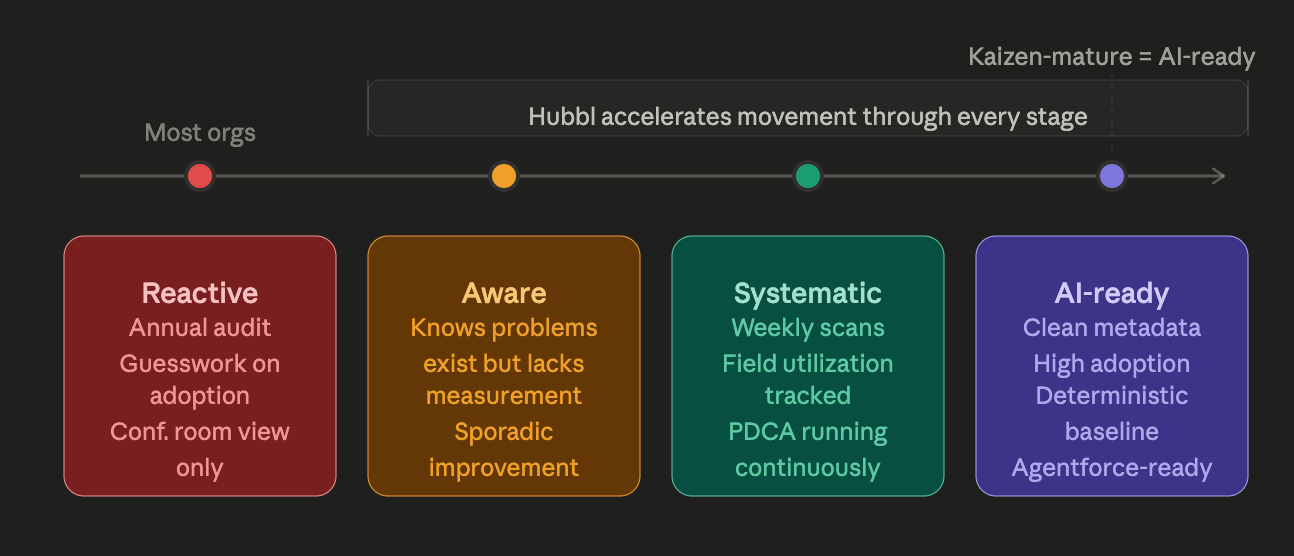
The prerequisites for successful Agentforce implementation are, almost item for item, the outcomes of a mature Kaizen practice applied to Salesforce: clean, well-understood metadata; standardized, consistently followed processes; high field utilization that ensures data quality; documented, rationalized automation; and an org that has been continuously improved to the point where its actual state matches its intended state.
In other words, a Kaizen-mature Salesforce org is an AI-ready Salesforce org. The practitioner who has spent years driving out waste, improving process adoption, and maintaining organizational intelligence through platforms like Hubbl hasn't just built a better CRM. They've built the foundation that AI agents require to be trusted with real decisions.
This is the insight that Kaizen organizations seem to arrive at intuitively, and that others are about to learn the hard way. You cannot shortcut your way to agentic maturity. You cannot deploy agents on top of a dirty org and expect them to perform. The work of continuous improvement that Kaizen demands isn't a precursor to the AI era. It is the AI readiness strategy.
And Hubbl sits at the center of that story: the intelligence layer that tells you exactly how ready your org is, exactly where the gaps are, and exactly what needs to improve before you hand your processes to an agent. Not someday. Now.
You don't have to be a certified Kaizen practitioner to recognize the problem this article describes. You just have to have sat in a board meeting where the Salesforce forecast didn't match reality. Or watched a CRM implementation fail not because the technology was wrong, but because no one could tell whether the processes were actually being followed. Or felt the quiet frustration of knowing your Salesforce org has drifted somewhere you can't quite see, in ways you can't quite measure.
That feeling, that gap between what your system is supposed to do and what it's actually doing, is exactly what Kaizen was designed to eliminate. And it's exactly what Hubbl was built to make visible.
Whether you've practiced Kaizen for twenty years or you've never heard the word gemba before today, the underlying conviction is the same: you cannot improve what you cannot see, and you cannot lead what you do not understand.
Your Salesforce org is your digital gemba. The processes that run inside it are your business processes. The adoption signals it generates are your leading indicators of organizational health. And for the first time, there is a platform that makes all of that legible, not just to the admin who manages it, but to the product owner who owns it, the executive who funds it, and the board that depends on it.
Kaizen and great Salesforce management both require the courage to see reality clearly, the discipline to measure it consistently, and the humility to keep improving regardless of how good things look today. The organizations that internalize this don't just have healthier Salesforce orgs. They have faster, more adaptable businesses.
We built Hubbl to give you that clarity. And we'd love to show you what it looks like in your org.
Interested in seeing Hubbl through a Kaizen lens? Schedule a demo and let's walk your org together.