.png)
When people talk about AI in software delivery, the conversation usually goes straight to execution:
And yes—those are real breakthroughs.
But there’s a bigger opportunity that many organizations are overlooking:
AI can help teams plan work better, groom faster, and continuously optimize the health of business-critical applications.
Because in the real world, the biggest delivery bottlenecks aren’t always in coding—they’re upstream:
That’s where Hubbl comes in.
Most teams don’t struggle because they can’t build.
They struggle because they don’t know what to build next, what to fix first, or what risks are quietly accumulating.
Modern business applications—especially Salesforce—are living systems. They evolve constantly, and over time they naturally accumulate:
Hubbl continuously monitors org health and surfaces risks and issues before they become outages, incidents, or expensive rework.
But identifying issues is only half the battle.
The real magic happens when teams can turn insights into action—quickly and consistently.
That’s why we’re excited to introduce a major new capability in the latest Hubbl release: the Hubbl–Jira integration.
With this new integration, teams can create Jira tickets directly from Hubbl Recommendations inside Hubbl Org Intelligence—making it easier than ever to operationalize org health and keep delivery moving.
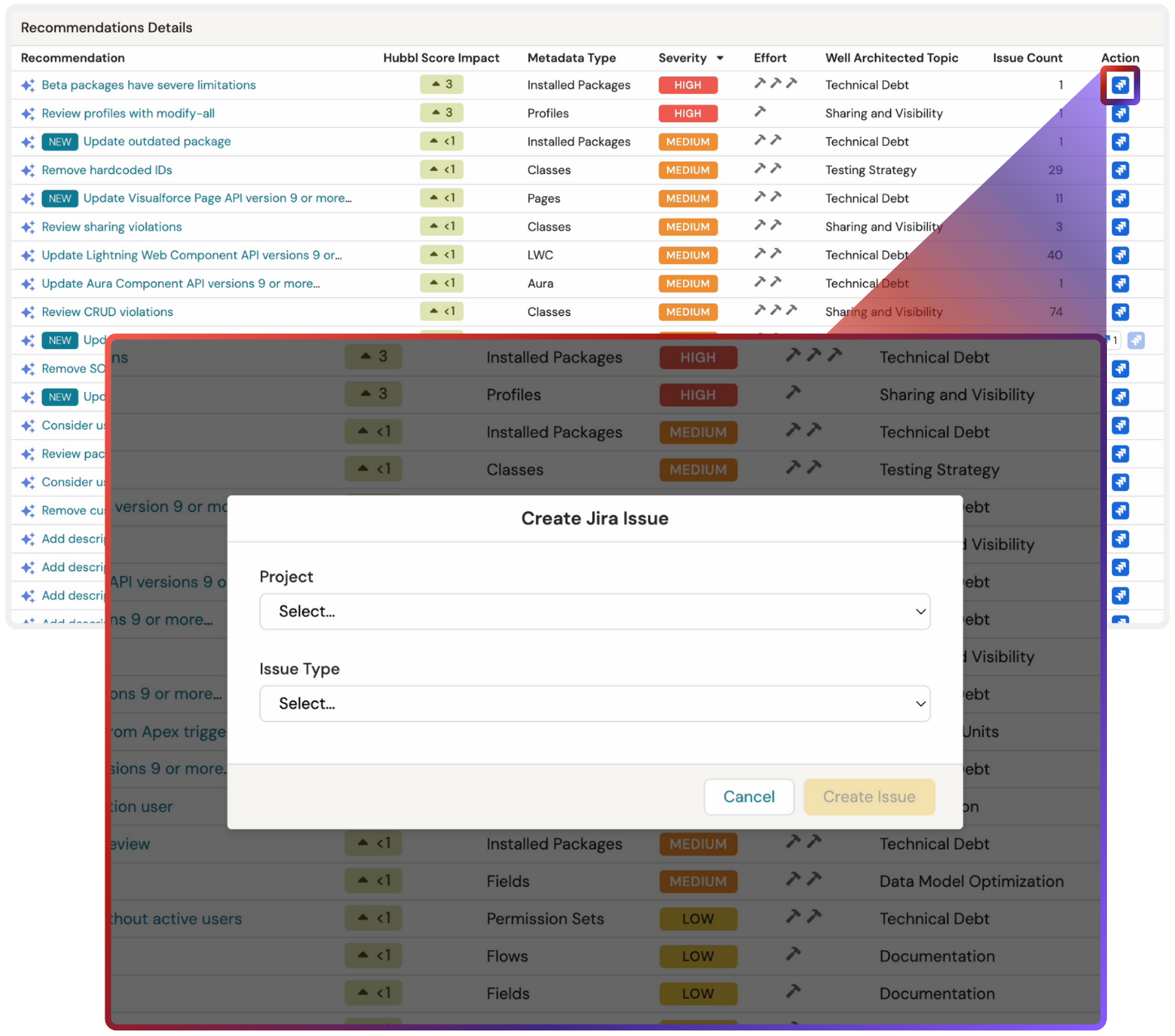
Hubbl Recommendations don’t just identify issues. They also include AI-powered prompts and story requirements to guide planning and execution.
That means instead of manually rewriting findings into Jira tickets, teams can:
This is how AI/ML transforms delivery: not only by doing work faster, but by ensuring teams do the right work first.
Salesforce delivery teams already plan and manage work in Jira.
Now, they can turn Hubbl’s continuous monitoring into a simple, repeatable workflow:
Instead of reacting to incidents and audits, teams can move into a new operating model: proactive delivery + continuous health optimization.
In the next era of software delivery, teams won’t measure success only by shipping features faster.
They’ll measure success by shipping features without creating long-term fragility.
That requires:
AI makes this possible—and Hubbl helps teams bring it to life.
The Hubbl–Jira integration is launching to Professional and Enterprise customers now, and we can’t wait to see how teams use it to turn org intelligence into real delivery momentum.
Want to enable it? Check out this quick video on getting started: